Lithium-ion batteries are one of the most successful technologies ever invented, and now span everything from smartphones to power stations — but the technology is not without its flaws and limitations, and scientists are now busy trying to figure out which type of next-gen battery will take over next.
One of the big safety risks with lithium-ion is thermal runaway, causing overheating and fires, and some future battery technologies are focusing on this in particular. One of the leading contenders, sodium-ion, just passed a major safety test at Hyundai, while this battery type is also showing lots of promise overall.
Here's what you need to know about the recent breakthrough we've seen with sodium-ion technology, what its benefits are more broadly, and how it might eventually overtake lithium-ion as the default battery chemistry of choice.
Hyundai, Unigrid, and the thermal runway
We know that lithium-ion batteries are a fire risk, and that's specifically where a US start-up called Unigrid is directing its attention. The company has developed a type of sodium-ion battery, using sodium chromium oxide (NCO) cell chemistry, which has just been given the safety seal of approval by South Korean giant Hyundai.
According to Unigrid (via Interesting Engineering), the batteries have now achieved "critical technology validation milestones" after being put to the test by Hyundai's technical evaluation program. Stringent safety experiments were completed with no fire and no thermal propagation (where fire spreads between batteries, an important consideration in factories and industrial use).
What's more, the sodium-ion NCO batteries showed "minimal capacity degradation" after sustained continuous cycling, while the units also held up under a wide range of temperatures: from -20C to 60C (that's -4F to 140F). This is only one set of tests in a limited number of scenarios, but the tech has passed with an excellent grade.
The key change here is given away in the name: sodium ions rather than lithium ions are shuttling between the positive electrode (cathode) and negative electrode (anode). Both battery technologies have actually been around for about the same length of time, but the superior energy density of lithium-ion is why it's won out in recent years. Now sodium-ion is increasingly being looked at again.
As well as potentially improved safety from a thermal runaway perspective, another key difference is that sodium is much more abundant and widely available than lithium is. That's becoming a more important consideration as the planet creaks under increasing environmental strain, and it means the raw materials are more affordable (though the overall cost of sodium-ion batteries remains higher than lithium-ion for now).
There's still a lot of work to do, as a 2026 review published in the Journals of Materials Chemistry A points out. The energy density problem remains, for example, which makes sodium-ion a more viable option for large-scale energy storage, rather than the batteries we've got inside our phones and tablets.
The future of sodium-ion
With all of that in mind, the thinking is that sodium-ion is more likely to exist alongside lithium-ion, at least in the shorter term. While the new batteries like those developed by Unigrid have plenty of potential, there are also plenty of challenges that need addressing.
As reported in Nature, the world's largest battery manufacturer CATL has announced that it'll start mass producing sodium-ion batteries before the end of 2026. The Chinese manufacturer says it has deals in place with both a car maker and a provider of energy-storage stations for electricity grids.
However, the sodium-ion ingredient mix is different in the CATL batteries: it's using a sodium-ion technology known as Prussian white, which is potentially cheaper to make, easier to manufacture at scale, and longer-lasting, though there are questions over the energy density of these batteries.
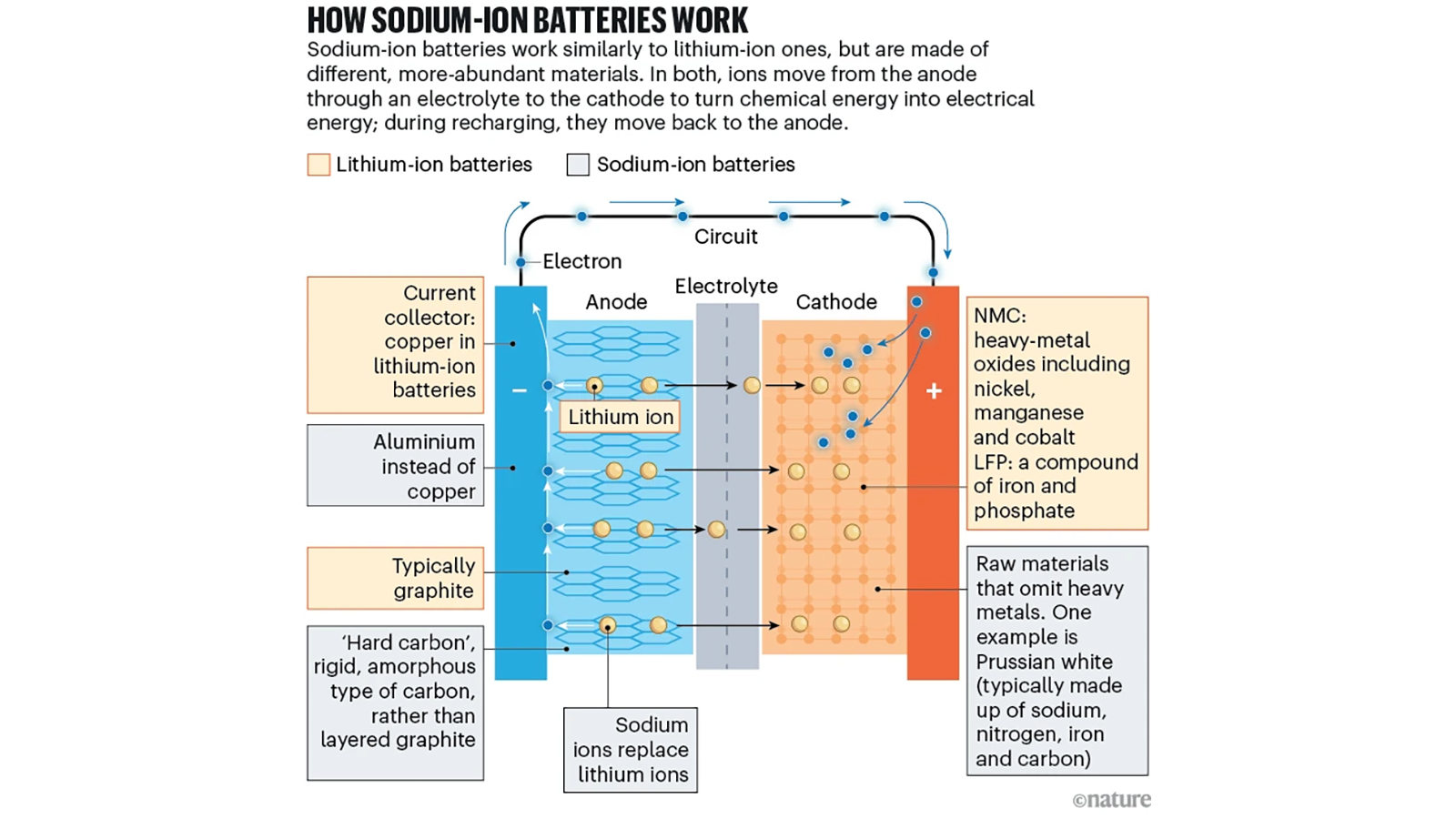
The good news is that rapid progress is being made in the areas where sodium-ion batteries still fall short. Researchers are looking closely at the different mixtures and chemical combinations that might work best for this — and some scientists have even floated the idea of removing the fixed anode materials in the battery altogether (so rechargeable batteries would work more like disposable batteries).
There are a lot of variables involved, from the stability of the world economy to the power demands that AI data centers continue to put on global energy networks, but we can expect to hear about plenty more breakthroughs with sodium-ion battery technology in the coming years.
"Sodium-ion batteries have emerged as a compelling alternative to lithium-ion systems, particularly for stationary storage and cost-sensitive mobility applications," writes Abu Faizal Abdul Salam et al in the Journal of Materials Chemistry A. "Continued efforts in materials research, standardization of testing methodologies, and real-world validation are pivotal to accelerate their path toward commercialization."
from Latest from TechRadar https://ift.tt/0syzNoI